Standalone vs. Gas Station Car Washes
Gas station car washes are good for a quick, convenient rinse when you're already filling up, but they're usually slower and offer less than a dedicated express wash.
If you've ever wondered whether gas station car washes are good (or bad), the honest answer is that it depends on what you need. A wash at the pump is built for convenience. A standalone express wash is built for speed, consistency and extras like drying and free vacuums. The biggest differences come down to how each one is set up, how long you wait, what you pay and what's included. Here's how they compare.
How the equipment differs: in-bay vs. conveyor tunnel
The core difference is what moves. At most gas station washes, your car sits still in a single bay while the wash equipment travels around it. At a dedicated express wash, a conveyor pulls your car through a tunnel while the equipment stays put.
That setup has a direct effect on speed. In a gas station bay, only one car can be washed at a time, so everyone behind you waits for the full cycle to finish before the next car pulls in. In a conveyor tunnel, cars move through in a continuous line, so several vehicles can be at different stages of the wash at once. The process is built to keep traffic flowing.
Which is faster?
A dedicated express wash is usually faster, both during the wash and while you wait in line.
The wash itself: In-bay washes run one full cycle for one car at a time. Express tunnels keep the conveyor moving, and at Quick Quack, you're in and out in 3 minutes or less.
The wait in line: This is where the gap tends to show up. At a gas station, the car ahead of you has to finish the entire cycle before you can start, and the bay may also be sharing space with people fueling up. In a tunnel, the next car is already lined up behind the last one, so the line keeps moving instead of stopping and starting.
Price and value: what you pay and what you get
Gas station washes are often the lower-priced option up front, but the price usually reflects a simpler wash with fewer extras. Here are the common pricing models you'll run into:
Added at the pump
You tack a wash onto your fuel purchase and get a code or receipt. It's convenient, but the wash is typically a basic single-cycle package.
Fuel-reward discounts
Some stations discount the wash when you fill up. It can be a good deal if you were buying gas anyway, though you're tied to that station's fuel and schedule.
Single washes
You pay per wash at either type of location. Higher tiers usually add things like wax or tire shine.
Unlimited memberships
You pay a flat monthly fee and wash as often as you like. These are far more common at dedicated express washes than at gas stations.
When you compare, look at cost per wash, not just the sticker price. A lower price for a basic wash can end up costing more per visit than a membership if you wash often. For a deeper look at what to check, see our guide on what to look for when comparing car wash memberships.
How a Quick Quack membership saves even more time
Speed isn't only about the wash. It's also about what happens before it starts. With a Quick Quack monthly membership, license plate recognition lets you enter the wash quickly, with no stopping to pay, scan or fumble with a card at the point of sale. A membership removes that friction and the added time that comes with it.
A monthly membership makes sense in two common situations:
You wash more than once a month
If you're washing multiple times per month, an unlimited membership typically beats paying per wash, and every visit is faster because there's no payment step.
You have more than one vehicle in your household
If you're washing multiple vehicles, Quick Quack's family plan discounts can make membership even better value.
If you wash once in a blue moon, a single wash may be all you need. But for regular washers, a membership is both the faster and the more cost-effective path. To see which wash type fits your car and routine, check out our guide to the best type of car wash for you.
What's included beyond the wash
The wash is only part of the experience. Here's what to look at once the soap and rinse are done:
Drying
Express tunnels typically finish with powerful dryers that blow most of the water off as you exit. Gas station bays often have a lighter dry cycle, which can leave more water spots if you don't hand-dry.
Add-on treatments
Options like wax, tire shine, undercarriage cleaning and ceramic-style protection are common at both, but dedicated washes tend to offer a wider menu and make them easy to add.
Towels
Some express washes provide towels or microfiber stations for finishing touches. At a gas station, you're more likely to bring your own.
Vacuums & Air Tools
This is one of the biggest practical differences. Express car washes are designed to give you a wash and a vacuum in the same stop, while gas stations won’t necessarily offer both.
Vacuum by the air pump vs. a dedicated vacuum area
A vacuum at a gas station is usually tucked next to the air pump, often coin-operated or pay-per-use, and shared with people filling tires or fueling up. You may need to stop and pay before you can start, and the timer can tick while you hunt for the right spot.
A dedicated vacuum area at a car wash is set up for the job. At Quick Quack, vacuums and air tools are not coin operated, so you can drive right up and start vacuuming without the hassle of another payment. That saves you time and keeps the whole visit moving.
When a gas station wash makes sense
Gas station washes aren't bad, they're just built for a different purpose. They can be a smart choice when:
- You're already fueling up and want to knock out a quick rinse in the same stop.
- You only wash your car occasionally and don't need a membership.
- A fuel-reward discount makes the wash cost little or nothing extra.
- There's no dedicated express wash nearby.
If your priorities are speed, thorough drying, free vacuums or washing often, a dedicated express wash is usually the better fit.
How the two compare on sustainability
The biggest sustainability difference is water, and how much a wash saves comes down to whether it reclaims and reuses it. Here's how the two types stack up:
Gas station washes
In-bay washes can reclaim water too, but the EPA's WaterSense program notes that the system has to be designed carefully because a bay typically has a single collection pit. It varies by location, so it's worth asking.
Express tunnels
Many tunnels use water reclamation systems that filter and reuse water throughout the wash. Facilities with water recycling and reclamation can save up to 85 gallons per wash.
Quick Quack
Quick Quack recycles up to 99 percent of the water used in each wash and uses as little as 21 gallons of fresh water per wash, which saves up to 79 gallons compared with washing at home. Its soaps are biodegradable and non-toxic, and because the system is closed-loop, Quick Quack doesn't deploy soap into storm drains.
If sustainability matters to you, ask any wash whether it reclaims water and how much.
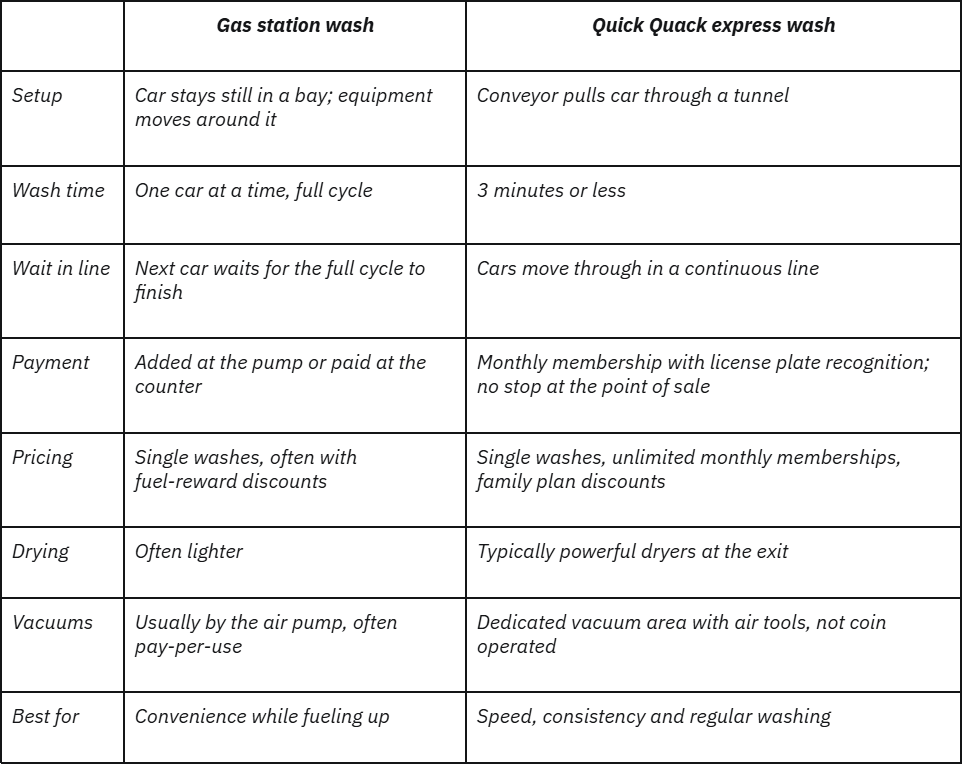
Gas station vs. standalone express wash at a glance
A quick checklist for sizing up any wash
Wait time
How long is the line, and how long does each car take?
Wash type
Does the car sit still, or does it move through a tunnel?
Drying
Will you drive away dry, or need to hand-dry?
Vacuums
Are they free and ready to use, or do you pay first?
Add-ons
Can you add wax, tire shine or undercarriage cleaning easily?
Payment
Is there a quick way to enter, like a membership with license plate recognition?
Cost per wash
What do you pay per visit based on how often you wash?
Household
Do you have more than one vehicle that could share a plan?
For a gas station, a quick rinse can be a handy add-on to a fill-up. For fast, consistent washes with drying and vacuums built in, an express tunnel with a membership is hard to beat. Find a Quick Quack near you and see how quick a wash can be.